
What B2B Event Marketing Is and Why It Matters
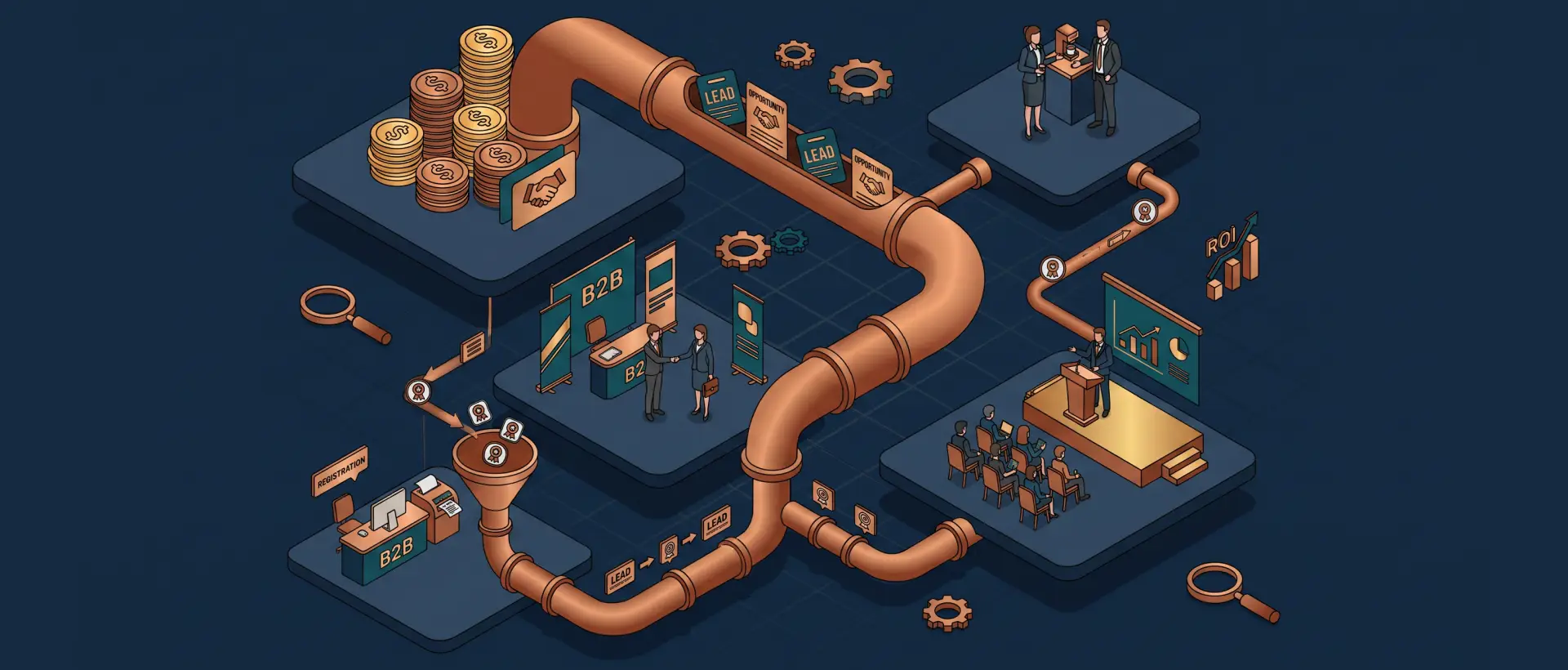
B2B event marketing is the practice of using in-person, virtual, or hybrid events as deliberate channels for pipeline, credibility, and relationship-building between businesses. Trade shows, conferences, webinars, product launches, and curated customer gatherings all count.
B2B event marketing is the strategic use of events to create direct, high-trust interactions between a company and its target buyers, designed to move those buyers toward a decision.
That definition matters because it sets the expectation correctly. An event is not a brand awareness exercise you run because the industry conference is happening anyway. It is a pipeline channel, and it behaves like one when you treat it like one. Every format, from a live conference presentation to a focused webinar, has a measurable role in an event marketing strategy.
The numbers are worth pausing on. 68% of marketers say events are their most effective marketing channel, not one of the most effective, but the top of the list. That is a strong signal that event lead generation, handled with a clear strategy, tends to outperform the channels that dominate most budget conversations.
The reason, I think, is proximity. A prospect who attends a session you ran, or spent twelve minutes at your booth, has made a small commitment. They already chose to spend time with you. The door is not just open; it is standing there, held, waiting for the follow-up to arrive.
Why Is B2B Event Marketing Important?
Events compress into a single room what every other B2B marketing channel tries to build across months: trust, recognition, and a reason to talk.
A well-executed event marketing campaign lets a company demonstrate, not describe, what it does. A founder presenting on stage is showing the room how they think. A product demo at a trade show lets a buyer feel the thing before they have committed to a call. That kind of evidence is genuinely hard to manufacture through content or paid media alone.
There are a few reasons this matters now more than it did five years ago.
- The trust gap in digital channels has widened. Buyers receive more outreach than ever and respond to less of it. A face-to-face conversation at an industry event, or a webinar where a real expert answers real questions live, cuts through in a way a cold email sequence rarely does.
- Events serve multiple pipeline stages in parallel. In-person event marketing generates net-new leads while warming mid-funnel prospects and accelerating conversations that have stalled.
- The post-event research moment is a real opportunity. Buyers who meet a company at a conference will search for it afterward. Event promotion strategies that build search and AI visibility before and after the event extend the conversation beyond the room.
- Events create content that keeps working. A recorded webinar, a speaker clip, a session recap, all of it feeds event marketing channels long after the date has passed.
- Investor and partner relationships often start here. For growth-stage companies, a conference or showcase is sometimes the venue where the most consequential conversation of the quarter happens.
The gap between knowing this and doing it well is where most teams get stuck. Only 38% of CMOs agree their events are performing well, which tells you the investment is already happening. What is missing is the strategy around it.
Events are one of the few channels where the quality of your thinking is visible in real time, in front of the people you most want to impress. That is a pressure worth preparing for.
The B2B Event Marketing Strategy That Connects Activity to Pipeline
A connected event marketing strategy treats the event itself as the middle of the campaign, not the whole thing. Most teams pour energy into the event day and then wonder why the pipeline numbers disappoint; the answer is almost always that the work before and after was underbuilt.
The framework below maps the three phases, the activities that belong in each, and who typically owns them. It is designed to be adapted, not followed rigidly.
| Phase | Key Activities | Goal | Typical Owner |
|---|---|---|---|
| Pre-Event | ICP targeting and invite strategy; landing page and registration flow; email and social promotion sequences; speaker and agenda content; paid amplification; media and partner outreach; sales briefing on who is attending | Fill the room with the right people, not just any people | Marketing lead, with sales input on target accounts |
| During Event | Branded booth or stage presence; live demos and presentations; structured lead capture (not just badge scans); meeting scheduling for qualified conversations; real-time social coverage; content capture (video, photos, quotes) | Create qualified conversations and capture the data to continue them | Field marketing, sales, and founder (if presenting) |
| Post-Event | Lead scoring and CRM handoff within 48 hours; personalized follow-up sequences by lead tier; recording and content distribution; retargeting of event attendees; pipeline reporting for leadership | Convert conversations into pipeline, and extend event reach through content | Marketing ops and sales, coordinated |
The pre-event phase is where event promotion strategies either set up a campaign or quietly doom it. Filling a webinar or conference booth with the wrong audience is not a small miss; it resets the entire effort. Promotion means finding the specific buyers you want in the room, not broadcasting to the widest available list. That work involves ICP definition, targeted outreach through channels where your buyers actually pay attention, and a registration experience that qualifies as it converts.
During the event, the instinct to capture everything is understandable but rarely useful. A badge scan is a name; a brief, structured conversation with a note attached to it is a lead. The teams that generate real pipeline from in-person event marketing train for this in advance: a shared shorthand for lead quality, a quick intake question that separates curious from ready, and a next-step offer ready for the conversation that goes well.
Post-event is where most of the value either compounds or evaporates. The window for a follow-up that feels warm rather than generic is short, probably 48 hours. After that, the conversation has already cooled. A strong post-event sequence tiers leads by conversation quality, personalizes the first outreach to reflect what was actually discussed, and routes each contact to the right next step rather than the same nurture email.
Promotion does not stop when the event ends. Speaker clips, session recordings, written recaps, and social content all extend the event's reach across marketing channels for weeks. A single well-executed event can supply content that feeds a company's search and social presence long after the venue has cleared out.
B2B Event Formats and When Each One Makes Sense
Choosing an event format before clarifying the pipeline goal is like choosing a venue before you know who is coming. The format should follow the objective.
Sixty-six percent of marketers say in-person events generated the most revenue in 2024 compared to virtual and hybrid formats. That is a meaningful signal, but it does not mean in-person is always the right answer. It means in-person events close better when you need to. Virtual event marketing and hybrid event marketing solve different problems: reach, accessibility, and the ability to put a recorded asset into the world that works indefinitely.
| Event Format | Best-Fit Goal or Situation |
|---|---|
| Trade show / Exhibition | Building brand presence in a crowded market; generating net-new leads from a concentrated ICP; trade show marketing suits companies entering or re-entering a space |
| Industry conference (as speaker or sponsor) | Establishing credibility and thought leadership; conference marketing works best when the founder or senior leader can present, not just exhibit |
| Webinar | Warming mid-funnel prospects; product education; webinar marketing is particularly effective for SaaS and technical products where the demo is the convincing |
| Virtual event / Summit | Reaching a geographically distributed audience; scaling attendance without scaling venue cost; virtual event marketing extends reach but compresses the trust-building window |
| Hybrid event | Serving both local and remote audiences from one production; hybrid event marketing requires more coordination but captures more of the pipeline potential |
| VIP dinner / Executive roundtable | Deepening relationships with a small number of high-value accounts or decision-makers; experiential event marketing at this scale often closes deals that months of email cannot |
| Roadshow / Field event series | Taking the message to multiple markets; useful for companies in expansion mode who need pipeline in cities they are not yet known in |
| Customer event / User conference | Retention, expansion, and advocacy; often underused as a corporate event marketing format given how directly it influences renewal and referral |
Format also shapes what collateral and content you need. A trade show booth rewards a clear one-liner and a visual brand that reads from ten feet away. A roundtable needs a conversation agenda and a moderator, not a slide deck. Webinar marketing lives or dies on the speaker's ability to make a technical point feel relevant to a specific buyer's situation. Each format has its own language, and matching the content to the format is as important as choosing the format in the first place.
For growth-stage companies in particular, the temptation is to enter every format available in a given quarter. The better instinct is to pick one or two, run them well, and measure before expanding. A single webinar done with real strategic intent will produce more useful data about your audience than four events spread thin.
Measuring B2B Event ROI: From Badge Scans to Closed Revenue
Event ROI measurement starts before the event, not after it. Setting success criteria in advance forces a conversation about what the event is actually for, and that conversation prevents the post-event rationalization that makes CFOs permanently skeptical of event budgets.
Forty-one percent of marketers struggled to measure ROI and create competitive events in 2024. That is not a tools problem. Most teams have access to a CRM and a spreadsheet. It is a metrics design problem: the measures get set after the event, shaped around the data that happened to be collected rather than the outcomes the business actually needed.
The table below covers the full funnel, from attendance through closed revenue, with a capture method for each metric.
| Metric | What It Measures | How to Capture It |
|---|---|---|
| Qualified leads generated | New contacts who match your ICP and showed genuine intent | Lead scoring framework applied at point of capture; sales team rates conversations within 24 hours |
| Meetings scheduled | High-intent conversations booked on the day or directly after | Calendar invites tagged to event source in CRM; meeting scheduler link in follow-up sequences |
| Cost per qualified lead | Event spend efficiency relative to lead quality, not volume | Total event cost divided by number of ICP-qualified leads; tracked separately from total registrations |
| Pipeline influenced | Revenue opportunities where an event interaction was part of the buyer's journey | CRM opportunity tagging by event; attribution model that captures multi-touch influence, not just first touch |
| Pipeline generated | Net-new opportunities that originated at the event | CRM source field on all new opportunities created within 60 days of the event |
| Closed revenue attributed | Deals where the event was a contributing touchpoint | Tracked through CRM close reporting, usually reviewed 90 to 120 days post-event |
| Cost per meeting | How efficiently the event budget produced high-value conversations | Total event cost divided by qualified meetings; a useful proxy when the sales cycle is too long for pipeline to close quickly |
| Content reach post-event | The extended value of session recordings, clips, and recaps | Views, shares, and search traffic on event content assets in the 60 days following the event |
Buyers list vendor-supplied event materials among the top five content formats with which they prefer to engage, which is a useful reminder that the collateral produced for an event does not retire when the event does. A well-designed one-pager, a recorded session, a thoughtful slide deck, these keep working through follow-up sequences and search. Counting only the on-day lead capture undervalues the full return.
The most useful event ROI conversation is the one that happens in the week before the event: what would success look like, in numbers, for the investment we are making? If that question produces uncomfortable silence, the event probably needs a sharper objective before it needs a bigger budget.
How a B2B Event Marketing Agency Can Extend What Your Team Builds
The fragmented agency relationship is one of the quieter budget drains in event marketing. A team hires a designer for the booth, a separate firm for paid promotion, and manages the CRM handoff internally, and then wonders why none of it feels connected. The problem is not the individual vendors; it is that no one owns the through-line from positioning to pipeline.
A capable b2b event marketing agency contributes something more specific than logistics or design in isolation. What it should actually deliver, across the event lifecycle, looks like this.
- Positioning before the event starts. The messaging that goes on the booth, the deck, and the speaker abstract should come from the same place. An agency that has done positioning work for B2B companies knows how to translate a complex product into the one sentence that earns a second conversation in a noisy room.
- Collateral that works beyond the event day. A one-pager built for a trade show should also work in the follow-up email sequence and on the website. Designing for the booth and no further is a common miss, and the cost is paid in diluted follow-up.
- Digital campaigns that extend event reach. Pre-event paid promotion targets the specific accounts you want in the room, not the widest available audience. Post-event retargeting reaches attendees who showed interest but did not convert on the day. This is how an agency supports b2b events with digital campaigns, treating the event as a moment in a longer paid and organic arc, not a standalone activation. For B2B teams building that arc across channels, a complete guide to b2b content marketing strategies covers the content infrastructure that makes event content compound.
- Search and AI visibility before and after the event. Buyers who meet a company at a conference will often search for it within hours. An agency that understands both event marketing and search ensures the company shows up credibly in that research moment, not just in the event app.
- Measurement design, not measurement retrospective. Setting the success criteria, the CRM tagging structure, the lead scoring logic, before the event means the data collected is actually useful afterward. This is distinct from cleaning up a spreadsheet of badge scans two weeks later.
- Coordinated execution across strategy, design, and technology. For industrial and B2B clients running events across multiple markets, the overhead of managing separate vendors for each function is real. Working with altorise a b2b marketing agency that holds strategy, design, and technical build in one place compresses coordination time and keeps the brand consistent across formats.
The agencies that contribute real event ROI are the ones that can answer this question before the brief is signed: what does a qualified conversation from this event look like, and how will we know we had one?
Frequently Asked Questions About B2B Event Marketing
Why is B2B event marketing important?
B2B event marketing creates high-trust, face-to-face interactions that compress months of digital relationship-building into a single conversation. Events let companies demonstrate expertise in real time, generate qualified leads from concentrated audiences of target buyers, and build the credibility that moves stalled pipeline. For growth-stage companies, events are often where the most consequential conversations of the quarter happen.
What are the types of B2B event marketing?
The main formats are trade shows and exhibitions, industry conferences (as speaker or sponsor), webinars, virtual summits, hybrid events, VIP dinners and executive roundtables, roadshows, and customer or user conferences. Each format suits a different pipeline goal: webinar marketing works well for product education, while in-person event marketing closes more directly when the buyer needs to feel the product before committing.
How do you promote a B2B event?
Effective event promotion starts with ICP-specific outreach rather than broad broadcasting. Combine targeted email sequences to named accounts, paid social aimed at job title and company size, partner and media co-promotion, and a registration page that qualifies as it converts. Pre-event content, speaker previews, and agenda announcements build anticipation while warming the audience well before the event date.
How do you generate leads from B2B events?
Event lead generation depends on structured conversation capture, not just badge scans. Train the team on a shared intake question that separates curious from ready. Offer a clear next step during the conversation itself, a meeting booked, a demo scheduled, a relevant resource sent. Score and route leads within 24 hours, while the context of the conversation is still fresh for both sides.
How do you measure B2B event marketing ROI?
Set success criteria before the event, not after. Define targets for qualified leads, meetings scheduled, and pipeline generated, and build the CRM tagging to capture each. Track cost per qualified lead and cost per meeting rather than total registrations. Review pipeline influence and closed revenue at 90 to 120 days post-event, accounting for the full sales cycle rather than expecting immediate attribution.