


What B2B Marketing and Sales Alignment Actually Means
B2B marketing and sales alignment is the state in which both teams operate from a shared definition of the ideal customer profile, agree on what makes a lead qualified, and hand off pipeline through a documented process that neither team disputes.
That sounds bureaucratic. It is not, in practice. Alignment shows up in ordinary moments: the marketing deck and the sales deck say the same thing about the problem the product solves; a lead arrives with enough context that the sales rep does not need to re-qualify from scratch; when a deal stalls, both teams look at the same data to understand why. The absence of these things is not a personality conflict between departments. It is a structural gap, and most growth-stage B2B companies have it.
The reason it matters at the revenue level is direct. When marketing and sales are pulling toward different interpretations of success, B2B lead generation volume climbs while conversion rates flatten. Marketing points to demand generation numbers; sales points to close rates. Both are right about the wrong thing. An aligned team measures itself on marketing influenced pipeline and revenue growth, not on channel metrics that stop at the handoff.
For a complete foundation on B2B content marketing strategies that connect to sales outcomes rather than stopping at traffic, the guide to B2B content marketing covers the structural decisions that make content useful to sales, not just visible in search.
Why Marketing and Sales Fall Out of Sync in B2B Growth-Stage Companies
The misalignment rarely starts with conflict. It starts with speed.
In a founder-led company's early days, the founder holds both the marketing narrative and the sales conversation in their own head. There is no gap because there is no handoff. As soon as those two functions separate into different people, or different teams, the gap opens. It does not announce itself. It appears as a slow bleed in sales velocity, as marketing qualified leads that sales deprioritizes without explanation, or as a funding narrative that sounds slightly different coming from the marketing deck than from the sales rep on a call.
The structural conditions that produce this are consistent. Marketing builds its strategy around content and demand generation metrics it can measure. Sales builds its motion around what closes, which is often different from what marketing assumed would close. Neither team has formally agreed on lead qualification criteria, so the SLA between sales and marketing exists only in theory, if at all. The CRM sits between them like a document nobody updates with the same discipline.
Forrester research found that only 56% of B2B marketing leaders believe marketing currently operates as a strategic partner in their organization. That number is interesting not because it is alarming, but because it names something founders already feel: marketing is being treated as a production function, running campaigns and generating assets, rather than as a co-owner of the revenue conversation.
The founders most ready to fix this are usually the ones approaching a raise, where GTM coherence becomes visible to outside scrutiny. A misaligned sales pipeline is survivable in a growth phase; it reads poorly in a board deck. For SaaS companies specifically, inbound marketing strategies that are built around real buyer questions tend to close the gap between what marketing produces and what sales actually uses, because the starting point is the buyer rather than the channel.
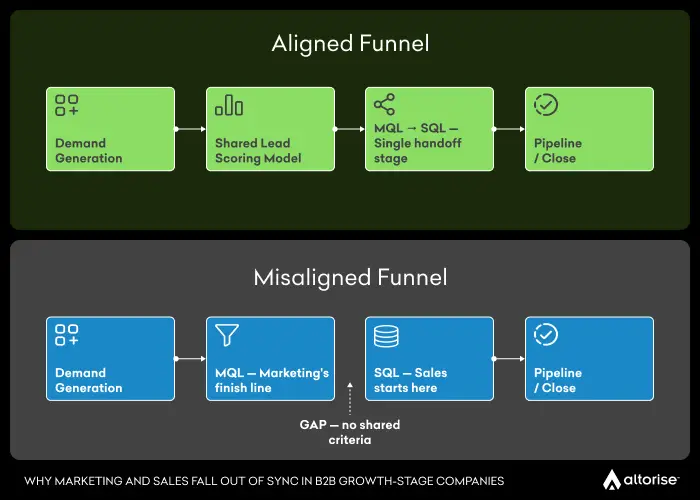
MQL-to-SQL drop-off is where misaligned funnels lose revenue; an aligned model collapses the gap into a single agreed handoff.
What Aligned Teams Do Differently: Marketing's Role in the Sales Process
Aligned B2B teams are not aligned because they get along. They are aligned because they have made a small number of structural decisions that remove the conditions for disagreement.
The first decision is a shared ideal customer profile, written once and used by both functions. Marketing uses it to target demand generation and content. Sales uses it to qualify inbound leads and prioritize outreach. When the ICP lives in one document that both teams have agreed to, lead qualification becomes a shared act instead of a judgment call that each function makes separately.
The second structural move is a service-level agreement between marketing and sales: marketing commits to delivering a defined volume of sales qualified leads meeting agreed criteria; sales commits to following up within a defined window. This sounds formal for a 30-person company. It does not need to be. A shared Notion doc and a standing weekly conversation accomplish the same thing without the overhead.
What marketing does for sales in a well-functioning alignment looks like this.
| Marketing's contribution | Sales benefit |
|---|---|
| Content built around real objections and buyer questions | Reps arrive at calls to an audience that has already processed the core arguments |
| Lead scoring based on behavioral signals, not just form fills | Sales pipeline reflects genuine intent, not volume |
| Account intelligence and firmographic data attached to each handoff | Reps spend less time re-qualifying and more time advancing |
| Campaign messaging that mirrors the sales narrative exactly | Buyers hear a consistent story across every touchpoint |
The return flow matters just as much. Sales feeds marketing with the objections that keep surfacing, the language buyers use to describe the problem, and the deal patterns that show which content or channel produced the highest sales velocity. Marketing analytics without that closed-loop input is measuring the wrong thing.
The founder who personally bridges both functions right now already knows what objections come up in every second call. That knowledge belongs in the content strategy, the AI marketing approach, and the lead scoring model. The gap is usually not awareness of the problem. It is not having a structure that puts the knowledge where it can work.
The truth about sales and marketing alignment in B2B is that it is less a culture problem than a sequencing problem: the right decisions, made once, remove most of the friction that teams spend months managing around.
How to Build a Sales and Marketing SLA That Both Teams Will Actually Use
A working SLA between sales and marketing is a short document with five components, and the test of whether it is working is simple: both teams can answer the same question about any lead in the pipeline without checking with each other first.
Most growth-stage teams skip this step because it sounds procedural. The cost of skipping it shows up later, when sales deprioritizes leads that marketing considers qualified, or when a hot account sits untouched for four days because nobody agreed on what "follow up fast" means. The SLA does not fix relationship tension. It removes the conditions that produce it.
Here is what belongs in one.
| SLA component | What it looks like for a growth-stage B2B team |
|---|---|
| MQL definition | A lead who works in a target-ICP role, has visited pricing or a solution page, and meets a minimum lead score threshold agreed by both teams |
| SQL criteria | MQL plus a completed discovery call or a direct request for a demo, confirmed by sales as worth advancing |
| Handoff window | Marketing notifies sales within 24 hours of MQL threshold; sales accepts or rejects with a reason within 48 hours |
| Follow-up cadence | First outreach within one business day of handoff; three touches over five days before marking as inactive |
| Feedback loop frequency | Weekly 30-minute sync where sales reports on MQL quality and marketing adjusts scoring or targeting criteria accordingly |
The right column is not a template to copy exactly. It is a starting point a team can argue with, which is the point. A document both teams have negotiated is a document both teams feel accountable to.
The SLA matters for revenue alignment because it converts an abstract shared goal into a set of commitments that can be measured. Marketing analytics becomes meaningful when you can trace a lead from the first content touchpoint through the handoff, through the sales follow-up, and into closed-won or closed-lost. Without the agreed handoff criteria, that trace breaks at the same place every time.
Lead Scoring, ICP Alignment, and the Feedback Loop That Keeps Both Current
Lead scoring degrades the moment it stops absorbing sales input. A scoring model built at the start of a GTM motion reflects assumptions about who buys and why. Deals teach you something different, and that difference compounds over time.
The practical problem is that most B2B lead generation teams build their scoring model once, celebrate its existence, and revisit it only when something goes visibly wrong. By then, marketing qualified leads have been quietly misrepresenting buyer intent for months, and sales has quietly stopped trusting the queue.
The fix is a cadence, not a platform. The weekly sync from the SLA is where this lives. Sales brings two things: the leads that converted and the ones that were right on paper but wrong in the call. Marketing brings the behavioral signals it is weighting in the current model. Together, they ask whether the model would have scored this week's best deals at the top and flagged this week's misses as low priority. If the answer is no, the scoring criteria need adjusting.
Account intelligence makes this sharper. When sales adds context to the CRM after each discovery call, including the language the buyer used, the objections that came up, and the buying committee structure, marketing has real material to refine both the ICP and the content strategy. The ideal customer profile stays accurate not because it was built carefully at launch, but because it is being updated by actual buyer behavior on a regular cadence.
The truth about marketing and sales alignment that does not appear in frameworks is this: the feedback loop is the alignment.
Scoring models and ICP documents are just the containers. What fills them is sales velocity data, closed-loop reporting from the CRM, and two teams willing to update their assumptions when the evidence shifts. Sales analytics fed back into demand generation strategy is where the ROI of marketing becomes visible, not as a channel metric but as a revenue number both teams recognize.
Measuring What Alignment Is Actually Worth: Pipeline Metrics That Tell the Story
Marketing-influenced pipeline is the number that converts an alignment conversation into a revenue argument. It answers the question leadership actually cares about: how much of the sales pipeline traces back to a marketing touchpoint, at any stage, before close?
That single metric does more for sales and marketing partnership than any culture initiative, because it makes marketing's contribution visible in the same language the sales team uses to report results.
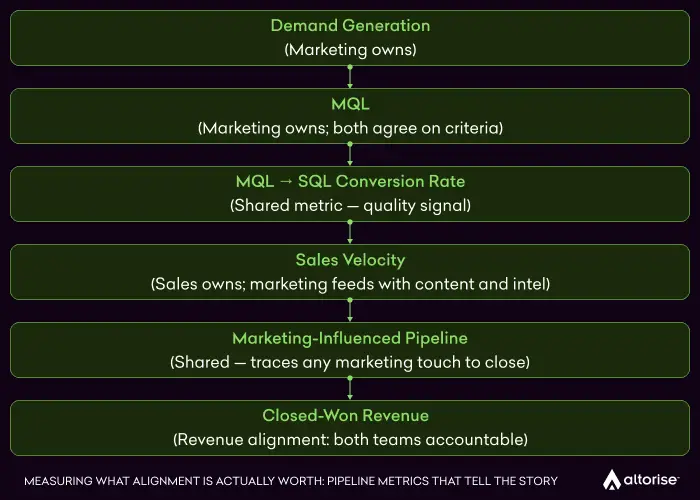
Each stage has a clear owner, but the metrics that matter most live in the shared middle.
Three numbers tell most of the story. MQL-to-SQL conversion rate shows whether lead qualification criteria are working as agreed. Sales velocity, the average time from SQL to close, shows whether the sales handoff is producing deals that move or stall. Marketing-influenced pipeline, measured as a percentage of total pipeline, shows whether demand generation is contributing to the business at a level worth the investment.
The shared dashboard matters less than the shared cadence. A weekly meeting where both teams look at the same sales analytics and ask the same questions is where these numbers become actionable. Without it, marketing analytics optimizes for impressions and traffic; sales analytics optimizes for close rate. With it, they optimize for the same revenue growth number, because both teams can see where the pipeline is sticking.
That is the truth about alignment that the culture conversation obscures: it does not require consensus on values. It requires two teams reading the same data and agreeing on what it means.
Where to Start When the Gap Between Teams Feels Wide
One conversation and one shared document are enough to start.
The conversation is not a workshop or an offsite. It is a standing 30-minute meeting where sales describes the last five leads it converted and the last five it deprioritized, and marketing listens for patterns without defending its work. That hour, repeated weekly, generates more usable insight than a full ICP audit because it is grounded in what actually happened this week.
The shared document is the ideal customer profile, written plainly enough that a sales rep can use it to qualify a call and a content writer can use it to choose a topic. If those two people would produce different outputs from the same document, it needs another draft.
Most founders approaching a raise discover the alignment gap at exactly the wrong moment: when investors start asking why the sales deck and the website tell a slightly different story. The fix is not to reconcile the decks. It is to build the shared narrative first and let the assets follow from it.
Alignment compounds. A scoring model calibrated this month is more accurate next month because sales has fed it another four weeks of closed-loop data. The sales-marketing collaboration that feels effortful at the start begins to feel structural, because it is. The pipeline metrics sharpen, the B2B buyer journey becomes legible across both teams, and the marketing qualified leads that sales once deprioritized start closing at a rate that settles the argument for good.
The starting point is smaller than the problem feels.
At Altorise, we work with B2B founders and sales teams who are somewhere in the middle of this gap, close enough to see the problem clearly, not yet sure where to pull first. The work is not always tidy, but the structure that comes out of it tends to hold.