


AI Search Has Changed Who Gets on the Shortlist
To improve brand visibility in AI search engines, you need entity clarity, topical authority, extractable content, and third-party corroboration across the channels AI systems actually index.
Entity clarity, topical authority, extractable content, and third-party corroboration are the four signals that decide whether a brand appears in an AI-generated answer or stays invisible while a competitor gets cited instead. Content volume does not move that needle, and neither does publishing frequency. Structure and corroboration do.
The shift is real and it is already affecting pipeline. Forrester reports that 94% of buyers now use AI in their research process, and G2's 2025 buyer behavior research found that 79% of software buyers say AI search has changed how they conduct research. When a buyer types a category question into ChatGPT or Perplexity, they are not browsing ten blue links. They receive a short answer naming two or three companies. If your brand is not one of them, that buyer's shortlist forms without you.
The companies showing up in those answers are not always the ones with the most content. They are the ones whose signals AI systems can read, verify, and corroborate. That is a fixable structural problem, and this piece addresses it systematically.
Who This Guide Is For
This is written for founders and marketing leads at B2B companies with an established product and some existing digital presence, companies in AI/SaaS, fintech, healthtech, professional services, and adjacent emerging industries. You have invested in content, maybe built out a B2B content marketing strategy, and your Google rankings are reasonable. But your brand does not appear when a buyer asks ChatGPT, Claude, Perplexity, or Google AI Overviews to recommend a solution in your category. If that gap is the one you are trying to close, this is for you. If you are also evaluating whether to bring in an AI marketing agency to own this end to end, the signal framework here will help you ask the right questions before that conversation.
What AI Search Engines Actually Use to Decide What to Surface
AI systems recommend brands they can understand, verify, and corroborate from sources they trust. That is the short answer. Pew Research found that about 58% of respondents conducted at least one Google search in March 2025 that produced an AI-generated summary. Every one of those summaries was built from signals the model could extract and cross-reference. If your signals are weak or inconsistent, you are not in the answer.
The four signal types below are the ones that actually determine AI search visibility. GEO (Generative Engine Optimization) and AEO (Answer Engine Optimization) are the practitioner names for optimizing these signals; LLM optimization is the same discipline applied specifically to large language model outputs. The terms overlap, but the underlying signals do not change.
| Signal Type | What It Means | Why AI Systems Weight It | Example Action |
|---|---|---|---|
| Entity clarity | Your brand, category, and differentiator are defined consistently across every owned property | AI systems build a knowledge graph; inconsistent naming creates ambiguous or missing nodes | Align your brand name, category label, and core differentiator across homepage, About page, and schema markup |
| Topical authority | Your content covers a defined subject area with depth and consistency | Models favor sources that demonstrate sustained expertise, not one-off posts | Publish a connected set of pieces on a narrow category, not scattered coverage across unrelated topics |
| Content extractability | Your answers are written in plain, self-contained sentences an AI can lift without surrounding context | AI Overviews and generative answers pull discrete, quotable sentences | Open each section with a direct declarative sentence; avoid answers that depend on earlier paragraphs to make sense |
| Third-party corroboration | Other credible sources name, cite, or link to your brand in a consistent context | AI systems treat external citations as verification; a brand only you mention is a brand an AI cannot verify | Earn mentions in industry publications, directories, and analyst content in your category |
The most common gap I see in audits is a brand that has invested heavily in content but has weak entity clarity and almost no third-party corroboration. The content is there; the signal structure is not. Before producing more pages, check whether the four signals above are in place on what you have already published.
Build the Foundation AI Systems Can Actually Read
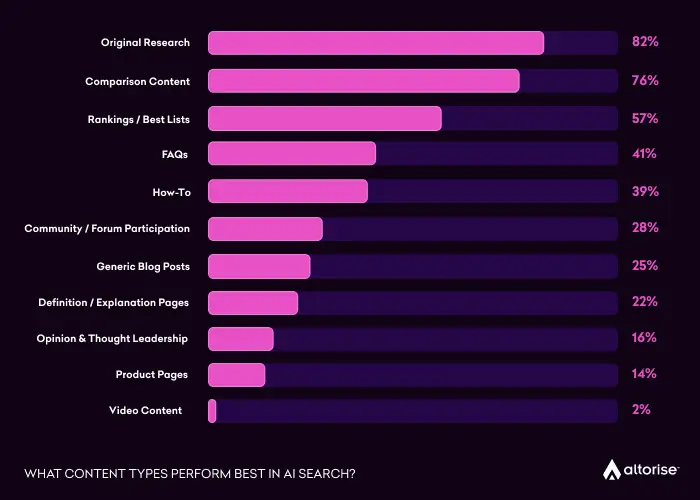
Your owned properties are the starting point. Before external signals compound, AI systems need to be able to read, understand, and index what you have built. A well-structured owned foundation is the precondition for everything else in an AI search discoverability strategy.
Five actions make the most difference here:
- Define your entity explicitly. Your homepage, About page, and product pages should state your brand name, the category you operate in, and your differentiator in plain language. Not taglines. Plain declarative sentences an AI can extract.
- Add schema markup. Organization schema, at minimum, connects your name, URL, founding information, and category in a machine-readable format. Product and FAQ schema extend that legibility to individual pages.
- Make category ownership explicit. Do not leave AI systems to infer what you do. State it directly on every primary page. If you build financial compliance software for mid-market banks, say that exactly, not "solutions for regulated industries."
- Check robots.txt and crawl access. Confirm that your robots.txt is not blocking AI crawlers, including GPTBot and other agents that feed LLM training and real-time retrieval. A blocked page has no path into an AI answer regardless of how strong its content is.
- Keep important content out of JavaScript rendering. Most AI crawlers do not execute JavaScript reliably. If your entity description, product details, or category statements live inside a JS-rendered component, they may never be read. Place that content in static HTML where any crawler can reach it on the first request.
- Maintain consistent brand language across owned pages. If your homepage calls you a "compliance automation platform" and your blog calls you a "regtech tool," AI systems may treat them as different entities. Pick the category label that matches how buyers search and use it everywhere.
This is the ground floor. Entity clarity built on owned properties is what makes third-party citations land on the right node in an AI system's model of your category.
Get Into the Channels AI Systems Actually Pull From

Increasing AI brand mentions means being named in sources AI systems treat as credible, not just publishing more on your own site. Owned content builds the foundation; off-site presence is what corroborates it. These are the five channel types that matter most, and why each one contributes differently to AI citation likelihood:
- Niche industry publications and ecosystem sites. Vertical-specific outlets carry more weight than general business media because AI systems infer category relevance from context. A mention of your compliance automation platform in a fintech regulatory news site lands differently than the same mention in a general tech roundup.
- YouTube. Transcripts and video descriptions are indexed and surface in AI answers. A five-minute explainer with a clear, keyword-accurate description creates a retrievable text artifact alongside the video itself. For categories where video content is active, this is an underused channel.
- LinkedIn articles and thought leadership posts. LLMs draw from professional publishing platforms, particularly for B2B categories. Whether a short post creates indexable signal depends on what it contains. A short post that presents original data or a clear, defensible position on a category question can surface in citations. A long article that restates common opinion usually will not. The format matters less than whether the content gives an AI system something specific enough to cite. If you are evaluating creators who build category authority through platform publishing, the same logic applies: a concrete claim with evidence outperforms length alone.
- Ranking listicle and roundup posts. Being named in a "top tools for X" or "best platforms for Y" post is one of the strongest selection signals available. AI systems treat these as aggregated third-party judgments. Getting into five well-trafficked roundups in your category is more valuable than five new blog posts on your own site.
- Community threads and forum mentions. Reddit, Quora, and niche community forums are indexed and cited by AI systems more often than most SEO plans account for. A thread where practitioners compare tools in your category, and name you by function, gives AI systems a peer-sourced text artifact. Contributing a clear, direct answer in the right thread carries more weight than a sponsored mention on a content site.
- Podcast appearances and episode show notes. Audio-to-text indexing is growing across AI platforms. A detailed show notes page that names you, your category, and your differentiator plainly gives the index a text artifact even when the audio is not directly processed.
These channels build corroboration signal today, but the underlying mechanism shifts as models update. Between August 16 and August 20 this year, ChatGPT's search tool call moved from JSON to a compact query language with freshness windows, domain targeting, and separate verticals for products, places, images, and widgets. What earns a citation in one model version may not survive the next. The principle of consistent category presence across independent sources holds, but the specific surfaces that carry weight need to be checked against current model behavior, not assumed from last quarter's observation.
Build Social Proof and Publish Data Where AI Systems Can Find It
Reviews on G2, Clutch, and Trustpilot are not just conversion signals; they are AI corroboration inputs. AI systems treat these platforms as third-party validation, and the language reviewers use shapes how AI models categorize and describe your brand. A brand with forty reviews using consistent category language is more likely to be cited than a brand with no review presence, regardless of content quality on its own site.
AI systems treat customer reviews as third-party validation. A brand with 40 reviews using consistent category language is more likely to be cited than a brand with no review presence, regardless of content quality on its own site.
The category language point deserves attention. If your customers call you a "compliance automation platform" in reviews and your homepage calls you a "regtech solution," AI systems aggregate two different signals. When you ask customers for reviews, give them a one-line prompt that names the category accurately. That is not gaming the system; it is helping your customers say precisely what you helped them solve.
Beyond reviews, publishing proprietary data matters. Original research, benchmarks, or even a well-structured internal survey, published on your own site and distributed to industry outlets, creates something AI systems can cite as a primary source. G2's 2025 buyer behavior research found that software review sites influence vendor shortlists at 15.1%, closely behind GenAI chatbots. That is a narrow margin, and it reinforces why these channels compound together rather than substitute for one another.
When you are defining the customer language you want reflected in reviews, the same exercise that produces a useful ideal customer profile also produces the category vocabulary to guide review prompts.
Create Content That AI Systems Quote, Not Just Rank
Content gets cited when it is written to be extracted, not just found. The structural difference between rankable content and quotable content is the opening sentence of each section.
Here is what that looks like in practice:
Before (unfocused, context-dependent): "There are many factors that contribute to how well a financial services company performs in search. Depending on your goals, technical SEO, content, and authority all play a role in your overall visibility strategy."
After (answer-first, extractable): "Financial services companies improve search visibility by fixing technical crawl issues first, then building topical authority across a defined set of category queries before investing in link acquisition."
The second version makes sense without the surrounding paragraphs. An AI system can lift it as a self-contained cited answer. The first version cannot be extracted usefully.
Three structural habits produce content that gets used in AI-generated search results. Open every section with a direct declarative sentence that answers the section's core question. Use specific, attributable statistics where possible; a vague claim about industry trends cannot be cited, but a number with a source can. Write definitions explicitly, with the term and its meaning in the same sentence, not separated across a paragraph.
These are editing habits, not content volume decisions. Reformatting existing pages in this pattern is often more efficient than publishing new ones, and it works on existing topical authority rather than diluting it.
Measure and Monitor Your AI Brand Presence
Tracking AI search visibility starts with a weekly manual check, not a dashboard. Run the core category queries a buyer would type into ChatGPT, Perplexity, and Google AI Overviews, and note whether your brand appears, where it appears, and how it is described. That ten-minute check, done consistently, gives you a baseline that no tool can substitute for because you are reading the actual language AI systems use to describe your category.
Four monitoring actions to run alongside that manual check:
- Weekly manual prompt testing (free, ten minutes). Test five to ten category queries across ChatGPT, Perplexity, and Google AI Overviews. Record brand appearance rate and note competitor brands that appear instead.
- Semrush AI Visibility Toolkit for citation tracking. Tracks which AI systems are citing your brand and surfaces gaps by query category. Use it to validate what manual testing suggests rather than as a replacement for it.
- Brand24 or Mention for AI mention alerts. Both tools surface brand mentions across web sources, including AI-generated content that gets republished or referenced. Set alerts for your brand name and your primary category terms together.
- Log brand appearance rate by query category to track AI search share of voice over time. Split queries into product, category, and use-case groups. A brand appearing in 3 of 10 product queries but 0 of 10 use-case queries has a clear content gap, not a general visibility problem.
If your company publishes voice-format content or targets conversational queries, the principles behind voice search marketing apply directly here: conversational, question-framing content indexes well across both voice and AI answer surfaces. The brand voice work that produces consistent language across owned pages also produces the consistent vocabulary that makes monitoring results interpretable, because you are tracking one clear entity, not several variations of the same name.
Measurement that cannot trace a gap to a named action is not measurement; it is reporting. When a query category shows no brand appearance, that is the specific gap to fix, and the sections above give you the signal types to address it.
What to Do Next: Sequence the Work in the Right Order
The right order to improve AI search visibility is foundation first, content second, channels third, social proof fourth, and measurement throughout. Trying to build channel presence before your entity signals are clear is wasted effort; AI systems cannot corroborate a brand they cannot properly identify.
- Fix entity clarity and owned signals. Align your brand name, category label, and differentiator across every primary page. Add Organization schema. Check that GPTBot and AI crawlers can access your site.
- Produce extractable content. Reformat existing pages to open each section with a direct, self-contained declarative sentence before publishing anything new. Structured content for AI search costs less than new content.
- Build channel presence. Earn mentions in ecosystem publications, YouTube video descriptions, LinkedIn long-form articles, and category listicles.
- Activate social proof. Collect reviews on G2 and Clutch using accurate category language. Publish one piece of proprietary data to create a citable primary source.
- Measure AI share of voice monthly. Track brand appearance rate by query category, adjust by signal type, and name the specific gap before deciding what to produce next.
If you want to understand how each of these steps connects to a broader growth strategy, the Altorise covers the sequence across positioning, content, and search. And if you would rather have a senior team own the full stack, Altorise runs search and AI visibility programs built around exactly this order of operations.
Frequently Asked Questions
What strategies improve brand visibility in AI search engines?
Entity clarity, topical authority, extractable content structure, and third-party corroboration are the four strategies that move AI brand visibility. Consistent category language across owned pages, schema markup, AI citations from credible third-party sources, and reviews on platforms like G2 and Clutch all compound toward being named in AI-generated answers.
How do I improve AI visibility for a B2B company?
Start by defining your category explicitly on every primary owned page, then earn mentions in vertical publications, ranking roundups, and professional platforms like LinkedIn. AI systems surface B2B brands when multiple independent sources describe them in the same category context. GEO and AEO tactics, meaning answer-first content and schema markup, sharpen how extractable those descriptions are.
How do I improve brand sentiment in AI search results?
The language AI systems use to describe your brand comes largely from third-party sources: reviews, analyst mentions, and publication coverage. Guide customers toward accurate category language when requesting reviews, and correct mischaracterizations in your own content by publishing clear, authoritative definitions of your positioning.
How do I measure my AI brand presence?
Run a weekly manual check across ChatGPT, Perplexity, and Google AI Overviews using five to ten category queries a buyer would realistically type. Log brand appearance rate by query group. Add a tool like Semrush's AI Visibility Toolkit to surface citation gaps at scale. The metric to track over time is AI search share of voice by query category, not total brand mentions.