

What B2B Brand Awareness Actually Does (and Why Most Companies Underinvest in It)
B2B brand awareness is the degree to which your target buyers recognize your company, associate it with a specific problem or category, and carry some impression of it before any sales conversation begins. That last part matters more than most companies give it credit for.
The commercial argument is precise. At any given moment, roughly 95% of your potential buyers are not in an active buying cycle. They won't respond to your ads, won't book a demo, and won't reply to outreach. The 95-5 Rule, developed by LinkedIn's B2B Institute, describes this plainly: the buyers who generate your future revenue are largely out-market right now, and the brand impressions you build with them today are what shape whose shortlist you appear on when their window finally opens.
This reframes the investment. Brand awareness isn't a soft precursor to "real" marketing. It's the asset that pays out when the buying trigger hits, months or years later, and you're already familiar rather than a stranger who needs explaining.
Most founders underinvest here because the feedback loop is slow and the metrics aren't as legible as cost-per-click. That's understandable. It's also expensive in the long run.
Why B2B Brand Awareness Works Differently Than B2C
In B2C, a strong visual, a memorable campaign, or a well-placed ad can move a buyer from awareness to purchase in a single session. B2B doesn't work that way, and applying a B2C playbook here is one of the quieter reasons awareness efforts stall.
The structural differences are real. A B2B purchase typically involves multiple stakeholders, each arriving with different concerns and different levels of familiarity with your company. The sales cycle runs months rather than days. Trust has to exist before anyone agrees to a first meeting, let alone an RFP. By the time a buying committee forms, the companies they consider are largely ones someone already knows.
This means brand awareness in B2B isn't about capturing attention at purchase. It's about building familiarity across a distributed audience over a long horizon, so that when a CFO asks the head of marketing who else they've evaluated, your name surfaces without prompting.
| Dimension | B2B | B2C |
|---|---|---|
| Buying cycle length | Months to years | Days to weeks |
| Number of decision-makers | 3–10+ stakeholders | Usually one |
| Role of trust before first contact | Essential; often determines shortlist | Helpful but not required |
| Content depth required | High; category education often needed | Lower; emotion and social proof often sufficient |
| Awareness-to-purchase timeline | Long; brand impressions compound slowly | Short; conversion can follow impression quickly |
The implication for b2b brand strategy is that awareness work is category education as much as name recognition. You're not just asking buyers to remember you. You're asking them to understand the problem well enough to recognize why your approach is worth a conversation.
The Benefits of Building Brand Awareness in B2B
When b2b brand awareness is working, the first thing that changes is the sales conversation itself. Introductions get shorter. The team spends less time establishing credibility and more time discussing the actual problem. That shift compounds across hundreds of calls in a year.
The benefits run further than sales efficiency, though.
Reduced friction at every stage. Buyers who recognize your brand enter conversations with a baseline of trust. They've seen your point of view, read your content, noticed you mentioned alongside a problem they care about. You're already partially vetted before the first touchpoint.
Better win rates when the window opens. If your b2b brand positioning is clear and consistent, buyers in an active cycle will have a stronger prior toward you than a competitor they've only just encountered. Familiarity tilts close rates even when the product specs are comparable.
Pricing power. A well-known brand in a category faces less pressure to justify its price. The buyer already has a sense of what the company stands for. Unknown brands negotiate harder because trust has to be built from zero inside the sales cycle, and urgency becomes the only lever.
Talent and partnership pull. Strong brand awareness attracts the people and partners who want to be associated with a credible name. Hiring gets easier. Distribution conversations open faster. This is rarely measured, but founders who have experienced both sides of it notice the difference.
The research supports keeping both levers running in parallel. The 50/50 budget split between brand and demand generation, which the IPA's long-running effectiveness data consistently surfaces, reflects how the two reinforce each other. Demand captures the 5% who are ready now. Brand awareness builds the preference that makes demand generation more efficient when the other 95% finally arrive.
The companies that wait until they have a conversion problem to invest in awareness are usually the ones working twice as hard for half the return.
B2B Brand Awareness Strategies That Build Recognition Over Time
A b2b brand awareness strategy works when it reaches buyers who aren't shopping yet, and gives them something worth remembering until they are.
The place most companies start, and the one that pays out most reliably over time, is thought leadership content. Edelman and LinkedIn surveyed nearly 3,500 management-level professionals across seven countries and found that decision-makers read thought leadership to inform their vendor shortlists, not just to stay informed generally. Content that names a specific problem, takes a position on it, and explains the reasoning behind that position does more for b2b brand equity than content that describes what a product does. The former builds category recognition. The latter requires the reader to already know they need you.
Thought leadership only lands if the voice behind it is consistent. A company that sounds authoritative in a whitepaper and vague on its website creates a gap buyers notice, even if they can't name what bothers them. Brand voice is the infrastructure that keeps content coherent across channels, teams, and time. It's less glamorous than a campaign, and more durable.
Channel selection matters more than most companies admit when they're trying to build brand awareness in a new market. LinkedIn, industry publications, and SEO-driven content each reach buyers at different moments in their thinking. Search, in particular, favors companies that publish consistently around the problems their buyers are researching, long before those buyers have a vendor in mind. A well-structured B2B content marketing approach treats this as earned visibility, not traffic acquisition.
The sequencing matters, too. B2B brand positioning comes first: you need a clear answer to what problem you understand unusually well before you can build recognition around it. Then content and channel strategy can amplify that point of view systematically, rather than producing volume without direction.
One thing worth saying plainly about b2b brand awareness tactics: the companies that drive brand awareness effectively aren't running a brand awareness campaign as a separate initiative. They're making the same argument, in the same voice, across every channel where their buyers pay attention. The repetition is the strategy.
What compounds isn't any single piece of content. It's the accumulation of a consistent point of view, showing up where the right people are, over a long enough period that familiarity starts doing the work that sales conversations used to carry alone.
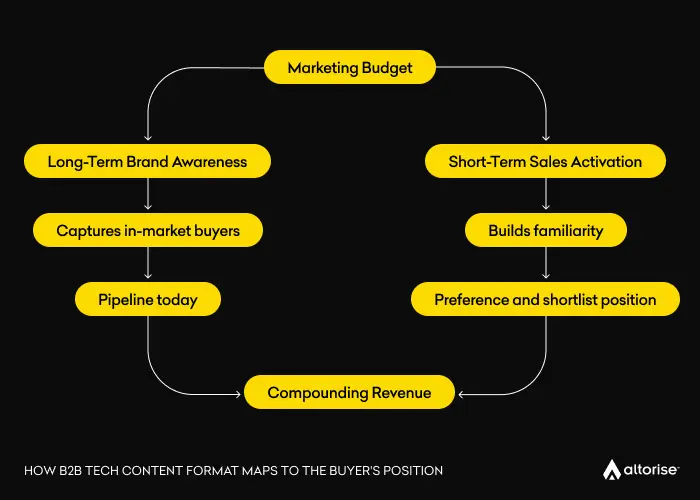
Brand and demand generation work on different timelines, but both paths converge on the same pipeline. The 50/50 balance reflects how each makes the other more efficient over time.
How to Measure B2B Brand Awareness Without Chasing Vanity Metrics
The measurement question is usually what stalls brand investment, not the strategy itself. Someone in the room asks how you'll know it's working, and if the answer is "impressions," the conversation goes sideways fast.
Better signals exist. Branded search volume, the number of people typing your company name into Google rather than a generic category term, is one of the most honest ones. It reflects whether awareness is actually forming in someone's mind, not just passing through. Share of voice, your brand's presence in a category relative to competitors across search, media, and social, gives you a comparative read on whether your position is growing or being crowded out.
Unaided recall surveys are underused and worth the effort. Ask a segment of your target audience to name companies they associate with a specific problem. The list they generate, unprompted, tells you more about b2b brand equity than any engagement metric. Pipeline source analysis adds the commercial layer: tracking how many opportunities come in with some prior familiarity with your brand, and whether those deals close faster or at higher values than cold-sourced ones.
Qualitative signals matter too. Not just whether you're being mentioned, but where and in what context. Being cited in an industry newsletter as a reference point for how to think about a problem is a different kind of signal than a product mention in a paid roundup.
The point isn't to justify the program. It's to give the strategy a feedback loop, so you can see which channels are building recognition and which are producing noise.