

What a B2B Content Marketing Strategy Checklist Actually Contains
A B2B content marketing strategy checklist is a structured audit tool that walks a team through every decision required to make content do commercial work: from audience definition and positioning, through content creation and distribution, to measurement and iteration. It is not a list of blog post ideas. It is not a content calendar. It is the framework that tells you whether the ideas and the calendar are pointing at the same goal.
Most checklists circulating online stop at "publish consistently" and "know your audience." Those are fine starting points, but they leave out the decisions that actually determine whether content compounds over time or just accumulates. A real checklist covers four connected layers: the strategic foundation (who you are trying to reach, what you need them to believe, and what action you want them to take), the content layer (what you will create and why), the distribution layer (how it reaches the right people, including how AI-driven search now resurfaces or buries content), and the measurement layer (what signals tell you it is working, before the pipeline shows it).
If you have been producing content for a while and cannot answer those four questions for your last ten pieces, this checklist is written for you.
Why a Documented B2B Content Strategy Compounds Where a Loose One Stalls
A documented content strategy does something an undocumented one cannot: it ensures every new piece of content strengthens the work that already exists. Instead of publishing isolated blog posts that compete for attention, each asset contributes to a connected knowledge base that builds authority, trust, and visibility over time.
Without documentation, content decisions are often reactive. Topics are chosen based on urgency, individual preferences, or available time, which leads to inconsistent messaging and scattered search performance. A documented strategy aligns every article, landing page, and campaign with a defined audience, business objective, and stage of the buyer journey.
This consistency creates a compounding effect. Search engines begin recognising your brand as a reliable source within a specific topic area, while prospects experience a clear narrative regardless of which page they discover first. The result is sustainable organic growth rather than traffic spikes that disappear once publishing slows down.
Documentation also improves execution internally. Writers, SEO specialists, designers, and subject matter experts work from the same priorities instead of interpreting goals differently. Leadership gains a clear framework for measuring progress, explaining investment decisions, and demonstrating how content contributes to brand authority, pipeline growth, and long-term business outcomes.
| Undocumented Approach | Documented Strategy |
|---|---|
| Content production depends on whoever has time that week. | Publishing follows a planned topic map aligned with audience needs and business goals. |
| Search visibility is spread across unrelated keywords and topics. | Topical authority grows consistently around clearly defined subject areas. |
| Content performance is difficult to connect to leads or revenue. | Every asset is mapped to a buyer stage and measurable business outcome. |
| Teams rely on repeated explanations to stay aligned. | Shared documentation keeps contributors aligned from day one. |
| The content programme appears fragmented to stakeholders and investors. | The business demonstrates a consistent narrative and growing category authority. |
Who This Checklist Is For, and How to Read It
This checklist is built for founders, heads of marketing, and GTM leads at growth-stage B2B companies, particularly in industries where content is expected to influence awareness, demand, and revenue. Whether you operate in SaaS, fintech, healthtech, web3, professional services, or manufacturing, the framework remains the same. Companies with longer sales cycles can adapt the distribution channels and content formats to match their buying process.
Read the checklist from start to finish the first time to understand how each phase connects. After that, use the table below as a quick reference to jump directly to the stage where your current strategy needs the most attention.
| Phase | Name | Primary Output |
|---|---|---|
| 1 | Audience and positioning | Documented ICP and differentiated narrative. |
| 2 | Goals and measurement framework | KPIs mapped to buyer journey and pipeline stages. |
| 3 | Topic and keyword architecture | Owned category terms, topic clusters, and search priorities. |
| 4 | Content formats and production system | A repeatable publishing workflow matched to audience intent. |
| 5 | Distribution and channel sequencing | A prioritised channel plan for maximum reach and engagement. |
| 6 | AI search and AEO readiness | Content structured for AI-generated answers and modern search. |
| 7 | Audit and iteration cadence | A scheduled review process with clear optimisation triggers. |
Each phase should leave you with a tangible output rather than just completed tasks. If you reach the end of a phase without a document, framework, or decision you can reference later, it is worth revisiting before moving on. Strong content strategies are built on documented decisions, not assumptions.
The B2B Content Marketing Strategy Checklist: All 7 Phases
Building a B2B content marketing strategy step by step means completing each phase in sequence, because each one constrains the choices in the next. Skipping phase one and going straight to editorial planning is how teams end up with a full content calendar and no coherent point of view.
Phase 1: Define Your Goals and Ideal Customer Profile
- Write down the one commercial outcome content needs to support in the next six months (pipeline, a raise, category entry).
- Document your ICP: industry, company size, role, and the specific trigger that makes them start looking for what you offer.
- List the three objections a qualified buyer raises before they sign. Your content will need to answer these.
- Confirm whether your positioning is differentiated enough to anchor a content program. If "trusted" or "experienced" are the best you have, the strategy will drift.
Phase 2: Map the Buying Journey
- Identify the stages your buyer moves through, from problem-aware to vendor-evaluating, and name each one plainly.
- For each stage, write the question a buyer is actually asking. Not the topic you want to cover. The question they type.
- Assign existing content to stages. Gaps are where new content goes.
- Note where buyers stall or drop out of your current funnel. Content often fixes that before a sales process change does.
Phase 3: Build Your Keyword and Topic Clusters
- Choose the two or three categories you want to own in search. These should align with your positioning, not just your product features.
- Research primary and secondary keywords for each category, including the phrasing buyers use rather than the phrasing your team uses internally.
- Group keywords into clusters: one pillar piece per category, supported by narrower pieces that link back to it.
- Check whether AI Overviews are already answering your target queries. If they are, note the source being cited. That is your actual competition.
Phase 4: Plan Formats and Your Editorial Calendar
- Match formats to stages. Awareness content can be a short post or a social thread. Decision-stage content usually needs depth: a case study, a detailed guide, or a comparison.
- Set a realistic publication cadence. One piece per week that is genuinely useful compounds faster than five pieces that are not.
- Build a twelve-week forward calendar with assigned topics, owners, and draft deadlines.
- Leave two slots per quarter for reactive content tied to category news or a buyer question that surfaces repeatedly in sales calls.
Phase 5: Create Content That Earns Trust
- Every piece should answer a real question, not just cover a topic. The difference is whether a buyer finishes reading and knows what to do next.
- Include practitioner detail: a pattern you have observed, a mistake worth naming, or a specific constraint that changed the outcome. Generic content does not compound.
- Cite proof where it exists. Where it does not, make the argument stand on reasoning. A weak statistic undermines the piece more than no statistic does.
- Have someone outside the team read the draft and tell you what it is actually saying. What they repeat back is the message. Whether that matches your intent is the edit.
Phase 6: Distribute Across Owned and Earned Channels
- Prioritize the channels where your buyers already spend time, not the channels where it is easy to post.
- Repurpose each piece into at least two formats: a long-form article becomes a LinkedIn post and a short email. The ideas travel; the writing changes.
- Build an email list from day one, even if it is small. Owned distribution is the only kind that does not depend on an algorithm.
- Identify two or three publications, podcasts, or communities where a guest contribution would reach your ICP. Earned distribution is slower to build but far more credible than paid placement.
Phase 7: Scale With SOPs and Repurposing
- Document your production workflow: brief, draft, review, publish, and distribute. Each step should have a named owner and a time estimate.
- Build a repurposing queue so that every piece of content feeds the next format without starting from scratch each time.
- Set a monthly review to check which pieces are generating traffic, leads, or sales conversations, and a quarterly review to update the topic clusters.
- Audit your content library once per year and update or consolidate pieces that no longer reflect your current positioning.
How AI Is Changing the Way B2B Teams Produce and Distribute Content
AI makes B2B content teams faster at the work that does not require judgment, and it raises the stakes considerably on the work that does. Researching a topic, drafting a structure, reformatting a long piece for different channels, and generating first-pass headlines are all tasks where AI tools save meaningful time. The risk arrives when teams let the same tools handle positioning, point of view, and proof, because that is where undifferentiated content floods the channel fastest.
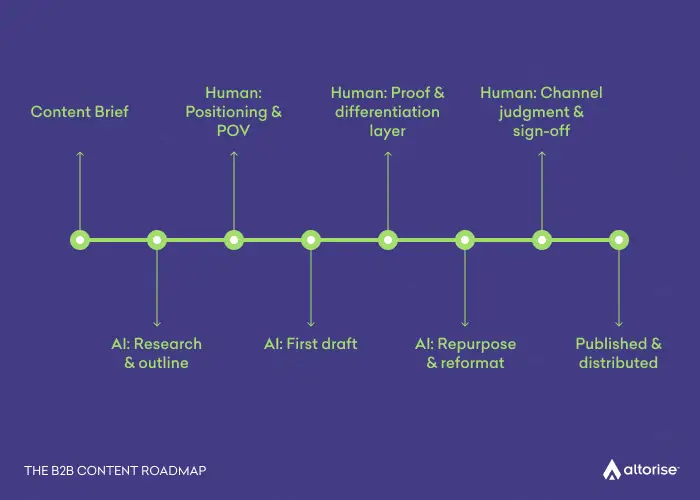
The B2B content roadmap: AI accelerates at research, drafting, and reformatting; human judgment governs positioning, proof, and distribution decisions.
For AI-generated answers to cite your content, structure matters as much as depth. Direct answers to specific questions, placed early in a piece, give AI systems something to extract. But the content still needs a perspective a language model would not generate on its own, because that is the signal that earns the citation over a generic competitor.
How to Measure ROI From a B2B Content Strategy
Pipeline influenced by content is the metric that actually answers whether the strategy is working, but it takes time to accumulate and requires CRM discipline to track. In the meantime, SEO and visibility metrics tell you whether the foundation is building, which is useful information before the pipeline numbers arrive.
SEO and Visibility Metrics
| Metric | What It Signals | How to Track It |
|---|---|---|
| Leads attributed to content | Whether content is generating qualified pipeline. | CRM with UTM tracking and first-touch/last-touch attribution. |
| Pipeline influenced by content | Whether content contributes to opportunities that eventually close. | CRM opportunity stage tracking against content touchpoints. |
| Sales cycle length for content-sourced leads | Whether content is educating buyers before they speak with sales. | Compare content-sourced and non-content-sourced deals in your CRM. |
| Content-assisted conversions | Whether individual assets influence revenue, even if they are not the final touchpoint. | Multi-touch attribution reporting within your analytics platform. |
Business and Pipeline Metrics
| Metric | What It Signals | How to Track It |
|---|---|---|
| Leads attributed to content | Whether content is generating qualified pipeline. | CRM with UTM tracking and first-touch/last-touch attribution. |
| Pipeline influenced by content | Whether content plays a measurable role in opportunities that close. | CRM opportunity stage tracking against content touchpoints. |
| Sales cycle length for content-sourced leads | Whether content is educating prospects before they engage with sales. | Compare sales cycle length for content-sourced versus non-content-sourced opportunities in your CRM. |
| Content-assisted conversions | Whether individual content assets are influencing revenue, even when they are not the final touchpoint. | Multi-touch attribution reporting within your analytics and CRM platform. |
The measurement system matters less than the habit of reviewing it. A quarterly read of these numbers, compared against the content produced in that quarter, tells you which topics are doing commercial work and which are filling a calendar without filling a pipeline. That review is also where the SOPs from phase seven pay off: if you have been tracking which pieces went out and when, the attribution question has at least a fighting chance of being answered.
Common Mistakes That Stall B2B Content Strategies, and How to Avoid Them
Most B2B content strategies do not fail at the execution layer. They fail earlier, in the decisions that preceded the first piece of content, or in the habits that settled in quietly afterward. Four patterns account for most of the stalls.
Producing content before positioning is clear. If the team cannot agree on what makes the offer distinctly useful to a specific buyer, the content will cover territory without claiming it. Diagnosis: your last five pieces could have been published by a competitor without changing a word. Fix: pause the calendar, document your differentiated position, and rebuild the topic map around it.
Treating distribution as an afterthought. Content written and then handed off to social with no channel strategy rarely finds the right audience. Diagnosis: your traffic is mostly direct or branded, meaning people who already know you are doing the finding. Fix: assign a distribution plan before the piece is written, not after it is published.
Measuring activity instead of pipeline impact. Page views and follower counts are easy to report and difficult to act on. Diagnosis: your monthly content report contains no number that a founder or investor would find meaningful. Fix: add one CRM-linked metric, even first-touch leads, and track it for ninety days before expanding the model.
Scaling volume with AI without a differentiating point of view. AI can produce a lot of content that says very little a competitor's AI is not also saying. Diagnosis: your recent pieces read as solid overviews with no observation a reader could not find elsewhere. Fix: each piece needs one practitioner claim, a pattern, a constraint, a specific failure mode, that comes from inside your operation rather than from a synthesis of public sources.
Frequently Asked Questions
What is B2B content marketing and how does it work?
B2B content marketing is the practice of creating and distributing content that helps a business buyer understand a problem, evaluate options, and move toward a purchase decision. It works by building trust across the buying journey rather than interrupting it, so that when a buyer is ready to choose a vendor, the company that has been most useful in the research phase carries a measurable advantage.
How is B2B content marketing different from B2C?
B2B buying involves multiple stakeholders, longer decision cycles, and significantly higher stakes than most B2C purchases. Content needs to address different roles at different stages, and it often needs to survive a procurement or finance review. Emotional resonance still matters in B2B, but it sits alongside rational justification in a way that B2C content rarely requires.
How long does it take to see results from a B2B content strategy?
Organic search results typically take three to six months to surface, and pipeline influence takes longer because it depends on deal cycles. The teams that see results fastest are those that document their strategy from the start and measure consistently, because they can identify what is working before the pipeline numbers confirm it. A B2B marketing planning checklist helps compress that learning curve.
What content formats work best for B2B?
It depends on the stage. Problem-aware buyers respond to short, opinionated posts and search-optimized guides. Buyers evaluating vendors need case studies, comparison content, and detailed guides they can share internally. A useful rule of thumb for any content marketing strategy checklist for B2B manufacturing exporters or SaaS teams alike: match the format's depth to the buyer's commitment at that stage.
How do I start if I have no existing content strategy?
Start with the audience and positioning layer, not the editorial calendar. Document your ICP, write down the three questions a qualified buyer asks before they commit, and identify the two or three topics your company is genuinely positioned to own. That foundation takes a week. Everything else, formats, cadence, distribution, builds on it, and skipping it is why most content programs feel like they are always starting over.
The checklist in this article is a framework, not a formula. A b2b export content marketing checklist for manufacturers will weight distribution channels and buyer education differently than one built for a SaaS company chasing AI search citations. What stays constant is the sequence: positioning before content, content before distribution, measurement before you scale. Get that order right, and the compounding takes care of itself over time.