
What B2B Cybersecurity Marketing Actually Has to Do
B2B cybersecurity marketing is the discipline of building enough institutional trust, in the right sequence, that a risk-averse enterprise buyer will stake their professional credibility on your product before a single contract is signed.
Most B2B marketing assumes the buyer wants to buy and needs a reason to choose you. Cybersecurity flips that. The buyer is managing a risk they are often reluctant to name inside their own organization, because admitting a gap carries political cost. The product gets evaluated not just on capability but on whether the vendor is safe to bring in front of a risk committee, a compliance officer, and a CISO who will eventually have to defend the decision to a board.
Familiarity, which awareness campaigns build reasonably well, is not the same as trust. In a security purchase, they are not even in the same conversation. A founder who applies standard inbound marketing strategies for SaaS companies to a cybersecurity product without accounting for this dynamic will find their pipeline stalling at evaluation, not because the product is weak, but because the marketing never built the institutional credibility a buyer needed before they were willing to proceed.
The Cybersecurity Marketing Society, a practitioner community that brings together marketers working across the discipline, surfaces this finding consistently in its research: buyers in security filter for sector-specific expertise early, and filter out vendors who sound generic before a conversation even starts.
Cybersecurity marketing is hard not because the products are complicated. It is hard because the buying environment is structurally hostile to the usual playbook, and most founders do not realise that until a deal quietly disappears in procurement.
How Cybersecurity Buyers Actually Make Decisions
Enterprise security buyers want one thing before they are willing to engage: evidence of institutional credibility that does not come from the vendor's own claims. Case studies from sectors they recognize, technical documentation that signals depth, content that demonstrates the vendor understands their specific compliance environment rather than the general threat landscape.
The typical B2B buying decision now involves 13 internal stakeholders, according to Forrester. In a security purchase, those stakeholders are not simply evaluating features. Each one is assessing whether the vendor's presence in their environment introduces new exposure. That is a different kind of scrutiny, and it requires a different kind of marketing asset at each stage.
Forrester also reports that more than 60% of business buyers now use a trial or proof-of-concept to evaluate solutions. In cybersecurity, that number carries particular weight. A trial means granting a vendor partial access to your environment. The marketing job, well before that conversation is even proposed, is to make a buyer feel that access is a reasonable thing to grant.
| Buyer Stage | What Moves Them Forward |
|---|---|
| Awareness | Category-specific thought leadership; AI search visibility for the precise threat or compliance question they are already researching |
| Evaluation | Technical proof (architecture docs, third-party assessments, sector-specific case studies); content that names their compliance framework directly |
| Procurement | Reference access; security documentation; a vendor brand that looks as enterprise-credible as the organization it is asking to trust it |
The awareness stage is where most cybersecurity marketing investment is lost. Founders build assets for the middle of this table before they have earned the right to be considered at the top. The sequence matters as much as the content itself.
The Positioning Problem at the Center of Cybersecurity Marketing
Wedge-first positioning means choosing the narrowest true claim you can own and expanding from there. It runs against every instinct a technically fluent founder has when they look at the size of the addressable market and feel pressure to speak to all of it at once.
The language of cybersecurity has been used so consistently across so many products that the words have stopped carrying information. "AI-powered," "zero-trust," "proactive defence," "next-generation." A buyer reading your positioning already discounts the phrase before they reach the claim. The result is that companies with genuinely differentiated products sound identical to the companies they have outbuilt, because they reached for the same vocabulary.
The category terms that feel safest are the ones most likely to make you invisible.
Security awareness training is a useful illustration. It was identified as a top cybersecurity investment priority by 19% of business leaders globally for 2026, which means real buyer intent sits behind a specific, nameable category. A vendor who speaks directly to that buyer in the language of their actual working day will be shortlisted before a vendor leading with the broader "security platform" claim. Specificity reads as understanding. Generic language reads as volume.
The contrast is practical, and it repeats across the category.
| Generic Language | Wedge-Specific Alternative |
|---|---|
| "AI-powered threat detection for enterprise security" | "Breach detection for healthcare systems operating under HIPAA audit pressure" |
| "Zero-trust network access" | "Least-privilege access control for distributed engineering teams managing cloud-native infrastructure" |
| "Proactive cyber defence" | "Incident response for mid-market fintechs navigating PCI-DSS re-certification" |
| "Next-generation endpoint protection" | "Endpoint visibility for OT environments where legacy SCADA systems cannot run agents" |
The right column does not try to speak to everyone. A buyer reading the specific version feels recognized; a buyer reading the generic version feels marketed at, which in a trust-sensitive category is close to being dismissed before a call is ever booked.
A cybersecurity marketing strategy built on wedge-first positioning gives the rest of the marketing stack something real to amplify. Without it, the most technically detailed content and the most carefully sequenced channel plan both arrive carrying the same problem: they sound like everyone else's.
Building the Content Engine That Earns Trust Before the First Call
Enterprise security buyers rarely contact a vendor cold. By the time a hand goes up, they have already spent months researching, and your content is what shaped their view of you during that time. The trust question is mostly settled before a conversation is ever scheduled.
The formats that earn that trust are not the ones most founders reach for first. Polished brand content and broad category overviews read as marketing; buyers in security are filtering for something closer to evidence.
- Practitioner-authored technical content. A post written by your lead engineer on a specific detection gap, in the language of someone who has actually worked the problem, signals expertise that polished "thought leadership" cannot replicate. Buyers read these to assess whether you understand their situation.
- Anonymous case studies with named verticals. You cannot name the client. You can name the sector, the compliance framework, the environment size, and the measurable outcome. "A 3,000-seat healthcare provider navigating HIPAA audit preparation" is enough for a similar buyer to feel recognized, and recognition is the point.
- Compliance-anchored explainers. A guide to what NIST CSF 2.0 means for a mid-market fintech is more useful to a security buyer than any category overview. It also signals immediately whether you understand their regulatory context, which is frequently the first filter they apply.
- Threat briefs written for a specific sector. Generic annual threat reports could apply to any industry, so buyers treat them as background noise. The Cybersecurity Marketing Society, a practitioner community that brings together marketers working across the discipline, has found consistently in its research that sector specificity is the credibility signal content volume cannot produce.
- Reference-able technical documentation. Architecture diagrams, integration specs, and security certification summaries sit at the procurement end of the buying journey. They are proof assets, not collateral, and they are frequently the difference between a deal that closes and one that quietly stalls.
AI search has added a practical layer to all of this. Every format needs to be structured so a language model can extract a citable answer from it. Cybersecurity content marketing strategies that ignore answer-engine optimisation are already losing visibility as buyers shift toward AI-assisted shortlisting. A header that frames a specific question, followed immediately by a direct answer, is the minimum viable structure for any piece you want surfaced in that environment.
The Channels Worth Your Attention in Cybersecurity Marketing
Depth over breadth is the only sequencing logic that holds in a trust-dependent sales cycle. A buyer who has read six of your founder's LinkedIn posts on a specific detection problem trusts your product more than a buyer who has seen your display ad a dozen times, because familiarity built through demonstrated expertise is a different thing from familiarity built through exposure.
The table below sequences channels by stage rather than listing them at equal weight, because when you activate a channel matters as much as which channel you activate.
| Channel | Why It Works for Security Buyers | Best Stage |
|---|---|---|
| SEO / AEO | Buyers research independently for months; content that ranks for specific threat or compliance queries reaches them at the exact moment of need | Early |
| LinkedIn (organic) | Practitioner credibility and founder visibility compound over time; trust transfers from the author to the brand in ways paid reach cannot replicate | Early and growth |
| Cybersecurity email marketing | High-intent subscribers who opted in for technical content convert at better rates than cold audiences; a well-run technical newsletter is among the clearest signals of genuine buyer interest | Growth |
| Webinars and long-form video | Technical walkthroughs let buyers assess competence before any conversation; a CISO who watches a substantive breakdown of a real attack scenario has already begun to decide | Growth |
| Community and peer networks | Slack groups, ISAC forums, and practitioner communities are where buyers exchange vendor references; presence here is earned through contribution, not bought | Growth and scale |
| Paid LinkedIn and intent-based retargeting | Efficient for reaching buyers who have already consumed your organic content; a poor mechanism for building cold trust in a category where buyers resist being sold to before they are ready | Scale |
A cybersecurity email marketing strategy built around a technical newsletter operates at a different register from demand-generation email. It assumes a reader who will unsubscribe the moment the content feels like a pitch. Founders who treat their subscriber list as a practitioner community first tend to find it converts more reliably at the growth stage than almost any other channel, partly because the buyers who stay have self-selected for genuine interest.
How to Differentiate When the Language Has Already Been Claimed
Specificity is the only positioning move that still works when every vendor has claimed the same vocabulary. The rewrite is not complicated: replace the category claim with the consequence, describing the buyer's actual situation at the moment your product changes it.
Three swaps that shift how a buyer reads your positioning.
Stop saying: "AI-powered threat detection for enterprise security."
Say instead: "Detection tuned to your cloud environment's specific attack surface, not a generic model trained on somebody else's incident data."
Stop saying: "Zero-trust network access."
Say instead: "Access control that assumes breach and limits the blast radius before your incident response team is even paged."
Stop saying: "Compliance-ready security platform."
Say instead: "Audit evidence generated continuously, so your next PCI-DSS review does not require a three-week scramble."
The pattern holds across all three. The generic version names a feature category. The specific version places the buyer inside a recognisable situation and names what changes.
Proof patterns follow the same logic. Rather than asserting "deep sector expertise," publish the anonymized case study that demonstrates it. Rather than claiming "enterprise-grade security," link to your SOC 2 report and name the auditor. Security buyers do not take assertions at face value; they look for the evidence behind the claim and form their view from that. Messaging that offers the evidence as the claim itself skips the step where trust has to be rebuilt from scratch.
The buyers who feel recognized in your positioning will not say so out loud. They will simply be more willing to take the next call.
What Good B2B Cybersecurity Marketing Actually Looks Like in Practice
A working B2B cybersecurity marketing strategy moves in sequence, and the sequence is the strategy. Positioning is not step one because it is more important in theory; it is step one because everything built on top of it either amplifies a specific, credible claim or amplifies noise, and noise at scale is expensive.
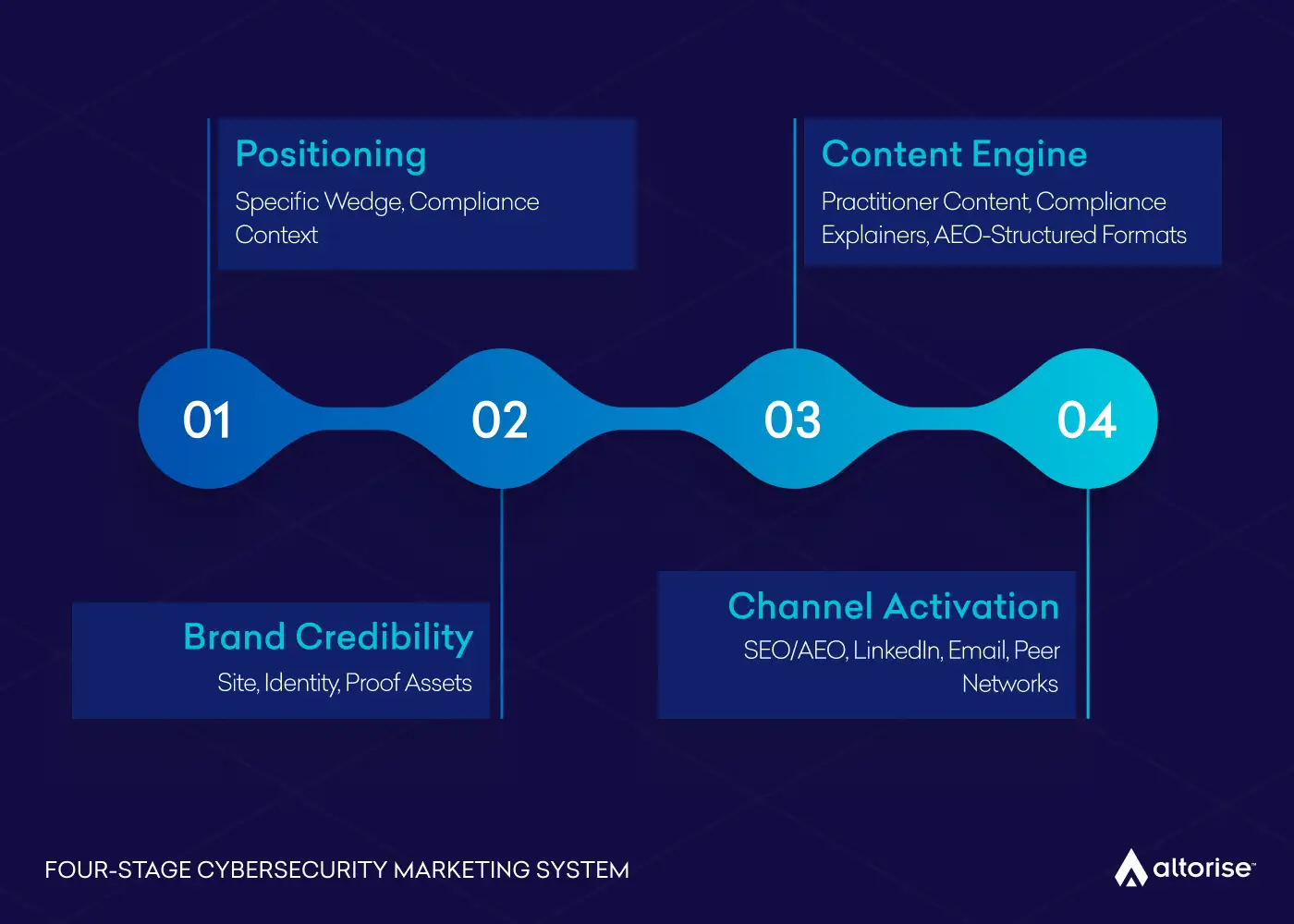
Each stage depends on the one before it; channels activated before positioning is settled tend to carry the wrong signal further.
A founder with a genuine detection advantage in OT environments starts by naming that advantage precisely, for a specific buyer, in a specific compliance context. That specificity shapes the website next. Visual identity and proof assets need to reflect the maturity level the product has actually reached, not an aspiration toward it. Sector case studies, architecture documentation, and relevant certifications do that work quietly and credibly.
The content engine follows, producing practitioner-authored material that answers the questions a buyer is typing into search and, increasingly, into AI-assisted research tools. Channels come last. Not because they matter less, but because they are most efficient when they carry something specific toward an audience that already has reason to pay attention.
Most cybersecurity founders lose ground in the gap between stages two and three. A complete guide to B2B content marketing strategies covers the broader mechanics, but in cybersecurity the stakes are higher because a buyer who encounters thin or generic content during a long research phase will simply move on without saying so.
The sequence is not a framework to decorate with tactics. It is what makes the tactics matter.
FAQ About B2B Cybersecurity Marketing
Why is marketing so difficult for cybersecurity companies?
The buyer's primary motivation is risk reduction, not solution adoption, and that changes everything. Every evaluation involves stakeholders whose professional obligation is to distrust vendor claims, in a category where a wrong decision carries real regulatory and operational consequences. Standard demand-generation frameworks assume a buyer who wants to be convinced. Security buyers want to be assured, and assurance requires proof, not persuasion. That is a harder brief, and most general marketing playbooks are not written for it.
What is message-market fit in cybersecurity, and how do you achieve it?
Message-market fit in cybersecurity means your positioning describes a specific buyer's risk environment accurately enough that they feel recognized rather than marketed at. You get there by narrowing the claim before you broaden it: name the compliance framework, the threat vector, or the environment type your product addresses best, then test whether a buyer in that context reads your messaging and thinks "this is built for my situation." Generic category language almost never passes that test, because the buyer has already read the same claim from six other vendors this quarter.
What role does content marketing play in cybersecurity branding?
Cybersecurity content marketing builds the institutional credibility a buyer needs before they will grant a vendor access to their environment. Practitioner-authored technical content, compliance-specific explainers, and anonymized sector case studies do the trust work that paid advertising cannot, because they demonstrate expertise rather than assert it. Structured correctly for AI search, that content also surfaces as a cited answer when buyers use LLMs to shortlist vendors, which is where an increasing share of early-stage research now happens. The Cybersecurity Marketing Society, a practitioner community bringing together marketers working across the discipline, has found consistently that sector specificity is the credibility signal content volume alone cannot produce.
How is cybersecurity marketing different from general B2B marketing?
The trust gap is deeper and the buying committee is more risk-averse. General B2B marketing can often close on ROI. In cybersecurity, ROI is secondary to a more fundamental question: is bringing this vendor into our environment a safe decision? That shifts the entire marketing emphasis toward proof, credentials, and institutional credibility. AI marketing tools have made it easier to produce content at volume, but volume is not the constraint in this category. Credibility is, and no tool resolves that on its own.
What does a B2B cybersecurity marketing agency actually do?
A cybersecurity marketing agency sequences the work a technical founder cannot sequence alone: positioning that names a defensible wedge, a brand that signals enterprise credibility, content built for the compliance and threat contexts the buyer lives in, and channel strategy calibrated to a long evaluation cycle. Working as an AI marketing agency with cybersecurity founders, Altorise runs that full sequence on secure, isolated setups, because the founders it works with understand better than most what data exposure actually costs. The work is not campaign execution dropped onto a brief. It is figuring out where a cybersecurity brand sits in a crowded market, what a buyer needs to believe before taking a meeting, and what content can carry that argument over a buying cycle that may run for months.